
Hale County Most Wanted Sources
Hale County does not publish its own most wanted list. The official Sheriff/Jail page offers phone numbers, jail book-in information, and a pointer to the state program, but nothing like a local fugitive roster or warrant spreadsheet appears there. No county reward schedule or photo gallery exists on the official site either.
So where does a searcher turn? The Sheriff's Office can route a warrant question to the right desk. The jail book-in line works too. For a specific warrant, the court or clerk that issued it holds the answer. A name on a statewide list should never be treated as proof of a Hale County case.
Texas DPS runs a 10 Most Wanted program that covers the whole state. Its entries change often, and each profile carries its own instructions. Counting those statewide fugitives tells you nothing about Hale County, though. The figures simply do not break down that way. The official DPS wanted-list page is what feeds the listings below.
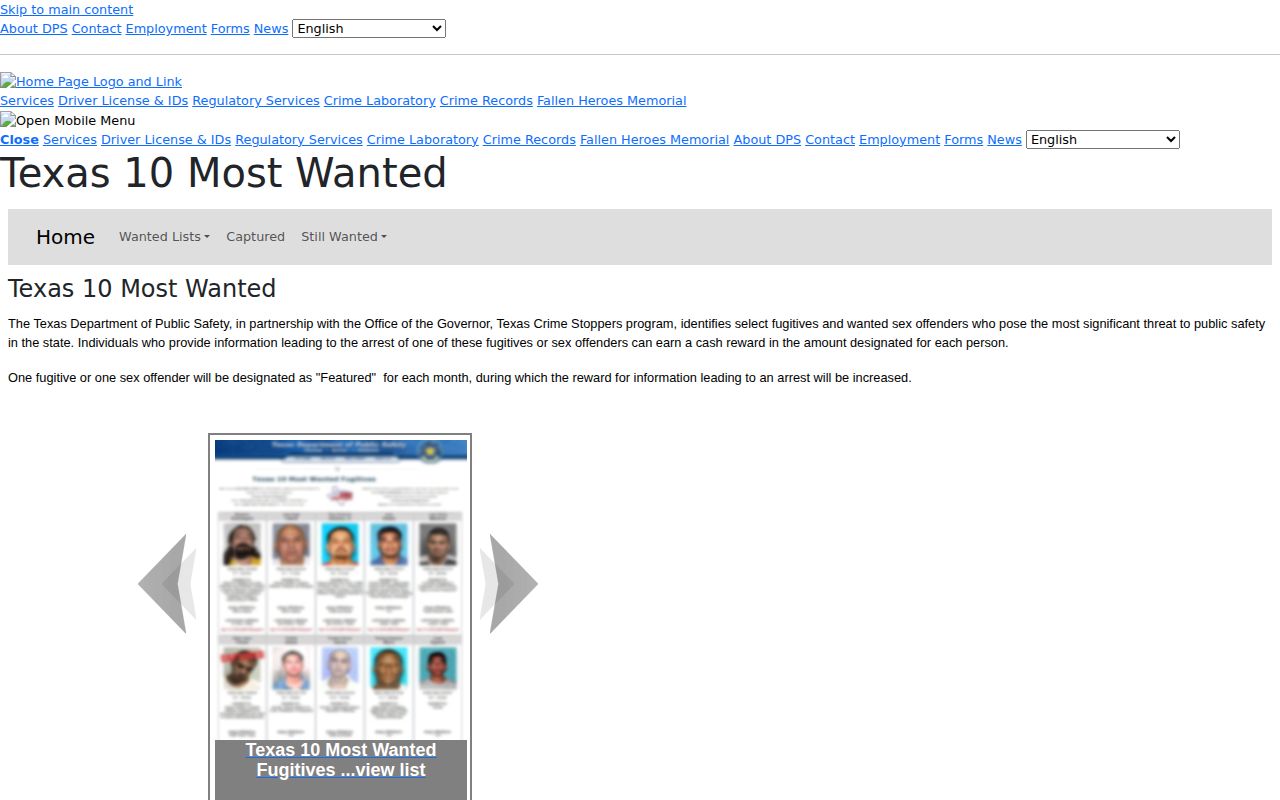
The DPS interface serves the whole state. It shows no Hale County roster. Its live entries come with agency instructions worth reading before you act on anything.
Note: A missing county web listing does not mean no warrant exists, and an online listing does not mean one is still active.
What Texas DPS Listings Show
A DPS entry is a public safety alert built by the state agency. It is not a Hale County booking record. Read the details in the live entry as identifiers. Follow the tip instructions attached there. Fields shift over time, so treat this as a description of what may appear rather than a fixed layout.
| Listing detail | How to read it |
|---|---|
| Name and aliases | Identity leads that still require confirmation with the named agency. |
| Photograph or description | DPS identification material, not a Hale County booking-photo gallery. |
| Offense or warrant context | An charge or law-enforcement notice, not a court conviction. |
| Agency or jurisdiction | The office that can explain the listing or receive an official tip. |
| Tip or reward instructions | Directions that apply to that current DPS entry, if DPS provides them. |
Names, photos, and physical descriptions can look alike across different people. A resemblance alone is no basis for an identification. Do not repeat what you see online as fact, and do not try to settle a question through social media. Court records are the later files that show how a case ended, whether by dismissal, a reduced charge, a plea, or a trial.
Using the DPS Wanted List Safely
Think of the DPS list as a bulletin board, not a to-do list. Seeing an entry is no reason to tail a car, knock on a neighbor's door, or confront someone who looks familiar. If a detail matters, hand it over. Give it to the channel DPS names or to local law enforcement. Let them take it from there.
- Open the current Texas DPS wanted-list page and read the scope of the individual entry.
- Check the named agency and the current official tip instructions instead of relying on reposts or historical news articles.
- If there is an immediate safety concern, call 911. For non-emergency local routing, contact the Hale County Sheriff's Office.
- Do not approach, follow, detain, or confront the person described in a listing.
Safety comes first. A wanted notice is not an invitation to act. Pass what you know to law enforcement, and let trained officers handle contact.
Old Plainview Herald crime stories mention a Crime Stoppers number. The current Sheriff/Jail page does not list it as an active Hale County program. It also does not publish current anonymity and reward terms. Those dated references do not count as a working tip line here. Use the live DPS instructions, or simply ask the agency where a tip should go.
Hale County Warrant Checks
No verified public warrant-search portal exists for Hale County. For a status question, call the Sheriff's Office at (806) 296-2724 or the jail book-in line at (806) 293-5377. Ask which warrants unit, court, or clerk handles confirmation. The Sheriff's Office sits at 1900 S. Columbia Street in Plainview. Phone staff can route you, but the issuing authority gives the definitive answer.
The court side has its own tool: the Tyler Civil and Criminal Public Access portal. It tracks filed criminal causes, docket events, and later case outcomes. A hit there still does not prove a warrant is unserved. Warrants get served, recalled, or quashed. A shared name can muddy a search.
When the portal is down or a record looks murky, try the County Clerk at (806) 291-5261. The District Clerk number is listed by the 64th District Court at (806) 291-5226. Confirm the court and cause number before asking for status. County-court and district-court files travel different paths.
Hale County Court Access Limits
The Tyler public-access system can be finicky. JavaScript settings, browser quirks, and access permissions all shape whether it loads. A failed search means just that. It is not proof a case or warrant is missing. When you call a clerk, be ready. Have the full name, any cause number, the court, and a rough event date in hand. A similar name can pull up the wrong file. That risk grows when a warrant and a booking come up in the same conversation.
The county clerk sits at 500 Broadway, Room 140, in Plainview. The 64th District Court works out of the Hale County Justice Center at 225 Broadway #5 and serves Hale, Castro, and Swisher counties. Those details help route a question. Still, only the clerk or issuing court can confirm the applicable record and current warrant status. A docket may show a filing or a disposition. The Sheriff's Office answers whether active process exists.
Check a Hale County Warrant
Have your details straight before you call. A full name helps, and a date of birth, city, approximate incident date, or cause number helps even more. Together, they let the agency pick out the right person from others with similar names. Avoid sending a blanket request for every name match. And never assume a private search result describes the person you actually mean.
- Identify the likely issuing place: a Hale County court, a city court, or another agency.
- Use the Tyler portal to look for a matching cause and docket history, noting that it is a court-record lead rather than an active-warrant confirmation.
- Call the Sheriff or jail book-in number for the current warrants-unit or clerk route, then contact the issuing office.
- Ask whether the warrant is active, recalled, served, or otherwise resolved, and ask what official process applies next.
- If the question concerns the caller's own warrant, contact the court, issuing agency, or a qualified attorney to address it lawfully and safely.
A warrant is court-authorized process that can direct law-enforcement action. Its status can change fast. An unofficial page or an old story about a prior arrest may linger online long after the paper is recalled or served. So the issuing office gets the final word.
Note: A court case, a jail booking, and a warrant may overlap in one matter, but they are not interchangeable records.
Hale County Warrant Types
The issuing court or law-enforcement agency decides what a warrant actually is and whether it stands. The labels below are general terms. They do not describe any specific Hale County case. Read the title on a portal or notice next to the court record. Then confirm directly with the source before drawing conclusions.
| Type | General meaning |
|---|---|
| Arrest warrant | A judge or magistrate authorizes an arrest based on the required legal showing. |
| Bench warrant | A court may issue it in connection with a failure to appear or comply with a court direction. |
| Capias | A court process that can direct an arrest or custody action in a criminal case. |
| Violation-related warrant | May concern a condition tied to a prior court order, bond, or supervision matter. |
Labels shift from court to court. They also shift with the posture of a case. A label alone tells you little. It cannot replace a look at the docket or a talk with the authority that issued the paper.
Why Hale Has No Verified Local List
Hale County keeps its official online presence geared toward contact information rather than lists. The Sheriff/Jail page points visitors to state resources, including DPS. But the official navigation shows no county wanted page. That gap is exactly why a careful Hale County most wanted search starts with the actual agency. A copied roster of names or photographs will not cut it.
Nothing supports claims about how many people are wanted locally. Nor does any source show when a supposed list was last updated. What a Hale entry would even display remains unknown. If the county ever publishes an official list, it would need a live source, an owner, a date, and posted terms. Without those, no one could call it a true Hale County resource.
Someone already in custody is a different matter. The Hale County record paths separate the booking, jail, court, and state-custody channels.
Hale County Official Contacts
Start with these published contacts for current routing. The official county page does not name a separate records officer or warrants unit, so ask whoever answers to point you to the right custodian or court contact for your specific matter.
Hale County Sheriff's Office / Hale County Jail
1900 S. Columbia Street
Plainview, TX 79072
Sheriff: (806) 296-2724
Jail/book-in: (806) 293-5377
County Clerk: (806) 291-5261
District Clerk: (806) 291-5226
Charges, warrants, and booking entries all trace back to an arrest, not a final outcome. Follow the case through the court to see where it lands.